A practical guide for UK radio amateurs
It’s a familiar story on the 2m band. You’ve been on the air for a while, a few stations are just out of reach, and someone at the club says: “You need a linear.” hooking your 100W rig up to a 1kW amplifier looks like the obvious way to be heard. But for most UK stations, a better antenna system will do far more, for less money, and with fewer headaches. Remember that being heard is only half of the story, you also have to be able to receive the other station too. So we will try and explain in more depth.
1. The decibel maths favour the antenna
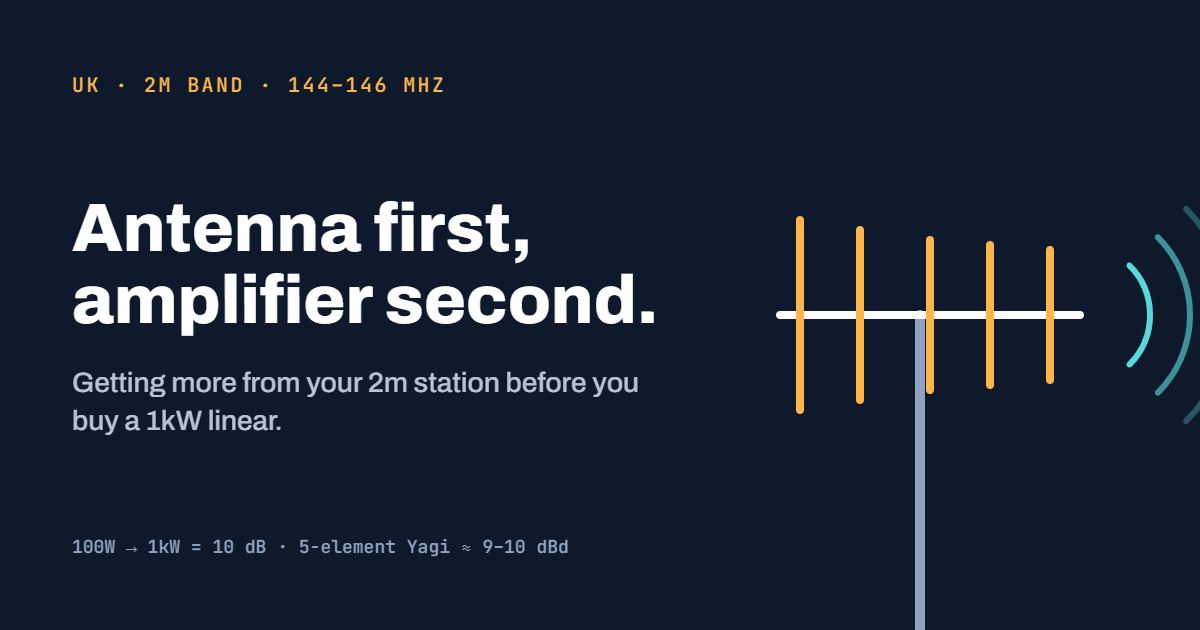
A typical 2m rig puts out 100W on FM or SSB. Adding a 1kW linear, the most a UK Full license now allows on 2m, sounds dramatic, but in signal terms it is exactly 10 dB: a tenfold power increase that works out to under two S-points on most receivers. Even doubling to 200W is just 3 dB, half an S-point and barely noticeable to the station at the other end.Compare that to antenna gain. A simple 5-element Yagi can offer roughly 9 to 10 dBd of forward gain, and a long-boom 9 or 10 element design more again. That’s the same 10 dB improvement as a 1kW amplifier, for the price of aluminum, a rotator and some good coax. Better still, it works in both directions.
Baying and Stacking antenna’s will give you even more gain to a point were it becomes pointless to add more antennas to the array.2. An antenna improves receive as well as transmit
This is the point most often missed. An amplifier only helps when you transmit. If you can hear a station only just above the noise, you can’t work them by shouting louder if you can’t hear their reply.A higher-gain, better-sited antenna improves your receive signal by exactly the same amount it improves your transmit signal. A directional Yagi also rejects noise and interference from the sides and rear, which is valuable in the UK where urban noise from LED lighting, switch-mode supplies, solar inverters and power-line adapters is an increasing problem even on VHF.
3. Feeder loss quietly eats your power
At 144MHz, coax losses are far from trivial. As a rough guide, over a 20 meter run:
4. Height and clear take-off matter more than watts
Remember in your foundation license training there was a whole section on antenna’s and clear space?
VHF propagation is largely line of sight, so 2m performance is dominated by antenna height and the terrain around you. A few extra meters of mast height, or moving an antenna from below the roofline to above it, can transform results. Many UK operators find their antenna is hidden by roof ridges, trees or neighbouring buildings.If you live in a hilly area, such as the Scotland, the Pennines, the Peak District or Wales, or have a coastal location, a good antenna at a good height can open paths that no amount of power would reach from a poorly sited one.You also need to think about polarization. By long-standing UK convention, FM, repeaters and packet use vertical polarization, while SSB and CW weak-signal work (around 144.300MHz calling) uses horizontal. Using the wrong polarization costs you many dB, which an amplifier will not fix.
5. Amplifiers raise the stakes on the rest of your station
An amplifier doesn’t solve system problems. It magnifies them.
6. License conditions and RF safety
Under the UK license, power limits depend on your class: Since Ofcom’s changes in February 2024, Foundation licensees are limited to 25W, Intermediate to 100W, and Full licensees to 1kW on 2m (all PEP). If you hold a Foundation or Intermediate license, an amplifier may simply not be an option until you upgrade, whereas you can improve your antennas at any time.As a licensee you’re also responsible for keeping RF exposure within the limits in your license conditions. Higher power combined with a high-gain antenna can increase field strength near the antenna, particularly if it’s close to your house or garden. Ofcom and the RSGB both provide guidance and calculators. Better to understand your exposure before turning up the power.
7. It’s usually the cheaper route
Prices vary, but as a general guide:
8. Planning and neighbours
One reason people avoid improving antennas is worry about planning permission. In the UK, whether you need consent depends on the type and size of antenna, where it is mounted and the property, particularly for listed buildings or conservation areas. Rules vary across England, Scotland, Wales and Northern Ireland, so check with your local council or the RSGB’s planning advice before erecting anything substantial. A tidy, well-sited installation is generally less contentious than a high-power station.
A sensible upgrade order
If you want the best result for your money, work through this in order:
Conclusion
An amplifier is a tempting shortcut, but it only increases transmit power. A better antenna system improves both what you send and what you hear, usually costs less, and stays useful as your station grows. When you do add a linear later, it will work into a well-matched, low-loss, well-sited antenna, and that’s when you’ll get the full benefit. For most UK 2m operators, the answer to “how do I get out better?” starts at the top of the mast, not in the shack.
Figures given are indicative. Always check current Ofcom licence conditions and RSGB guidance before changing your station.
Most importantly if you improve your antenna system, you will improve your ability to hear as well as transmit, improving your enjoyment of the hobby also. I hope this wee guide has been worth a read.
Tell us how can we improve this post?

Hi I am Marcus, MM0ZIF, a licenced Radio Amateur, Doctor of Musicology, amateur weather enthusiast. I over the years have been a Amateur Radio Tutor, Examiner, and a Regional Manager for the Radio Society of Great Britain.
This site is dedicated more towards Amateur Radio and Weather, with an angle on Technology too. I also maintain https://havenswell.com/ which is my other blog which is more aimed at cooking, hobbies and life in general as well as businness and networking.
- MM0ZIF

- MM0ZIF

- MM0ZIF
- MM0ZIF

- MM0ZIF

- MM0ZIF
- MM0ZIF
- MM0ZIF
- MM0ZIF
- MM0ZIF
- MM0ZIF

- MM0ZIF

- MM0ZIF

- MM0ZIF
- MM0ZIF
- MM0ZIF
- MM0ZIF

- MM0ZIF
- MM0ZIF

- MM0ZIF

- MM0ZIF

- MM0ZIF

- MM0ZIF
- MM0ZIF

- MM0ZIF

- MM0ZIF

- MM0ZIF

- MM0ZIF
- MM0ZIF

- MM0ZIF

- MM0ZIF
- MM0ZIF

- MM0ZIF

- MM0ZIF
- MM0ZIF
- MM0ZIF
- MM0ZIF
- MM0ZIF

- MM0ZIF
- MM0ZIF
- MM0ZIF

- MM0ZIF
- MM0ZIF

- MM0ZIF

- MM0ZIF
- MM0ZIF
- MM0ZIF
- MM0ZIF

- MM0ZIF
- MM0ZIF

- MM0ZIF
- MM0ZIF
- MM0ZIF
- MM0ZIF
- MM0ZIF
- MM0ZIF
- MM0ZIF
- MM0ZIF
- MM0ZIF

- MM0ZIF
- MM0ZIF

- MM0ZIF
- MM0ZIF
- MM0ZIF

- MM0ZIF
- MM0ZIF

- MM0ZIF

- MM0ZIF

- MM0ZIF

- MM0ZIF

- MM0ZIF

- MM0ZIF

- MM0ZIF

- MM0ZIF

- MM0ZIF

- MM0ZIF

- MM0ZIF

- MM0ZIF

- MM0ZIF

- MM0ZIF
- MM0ZIF
- MM0ZIF

- MM0ZIF

- MM0ZIF

- MM0ZIF

- MM0ZIF

- MM0ZIF
- MM0ZIF
- MM0ZIF
- MM0ZIF
- MM0ZIF
- MM0ZIF
- MM0ZIF
- MM0ZIF
- MM0ZIF
- MM0ZIF
- MM0ZIF
- MM0ZIF

- MM0ZIF

- MM0ZIF

- MM0ZIF

- MM0ZIF

- MM0ZIF

- MM0ZIF

- MM0ZIF

- MM0ZIF
- MM0ZIF

- MM0ZIF

- MM0ZIF

- MM0ZIF

- MM0ZIF

- MM0ZIF
- MM0ZIF

- MM0ZIF

- MM0ZIF

- MM0ZIF

- MM0ZIF
- MM0ZIF

- MM0ZIF

- MM0ZIF

- MM0ZIF
- MM0ZIF

- MM0ZIF

- MM0ZIF

- MM0ZIF
- MM0ZIF
- MM0ZIF

- MM0ZIF

- MM0ZIF

- MM0ZIF

- MM0ZIF
- MM0ZIF

- MM0ZIF

- MM0ZIF

- MM0ZIF
- MM0ZIF

- MM0ZIF

- MM0ZIF

- MM0ZIF
- MM0ZIF

- MM0ZIF

- MM0ZIF

- MM0ZIF

- MM0ZIF

- MM0ZIF
- MM0ZIF
- MM0ZIF

- MM0ZIF

- MM0ZIF
- MM0ZIF
- MM0ZIF
- MM0ZIF
- MM0ZIF
- MM0ZIF

- MM0ZIF
- MM0ZIF
- MM0ZIF

- MM0ZIF
- MM0ZIF

- MM0ZIF

- MM0ZIF
- MM0ZIF
- MM0ZIF
- MM0ZIF

- MM0ZIF
- MM0ZIF
- MM0ZIF

- MM0ZIF

- MM0ZIF
- MM0ZIF

- MM0ZIF
- MM0ZIF

- MM0ZIF
- MM0ZIF
- MM0ZIF
- MM0ZIF

- MM0ZIF
- MM0ZIF

- MM0ZIF
- MM0ZIF