
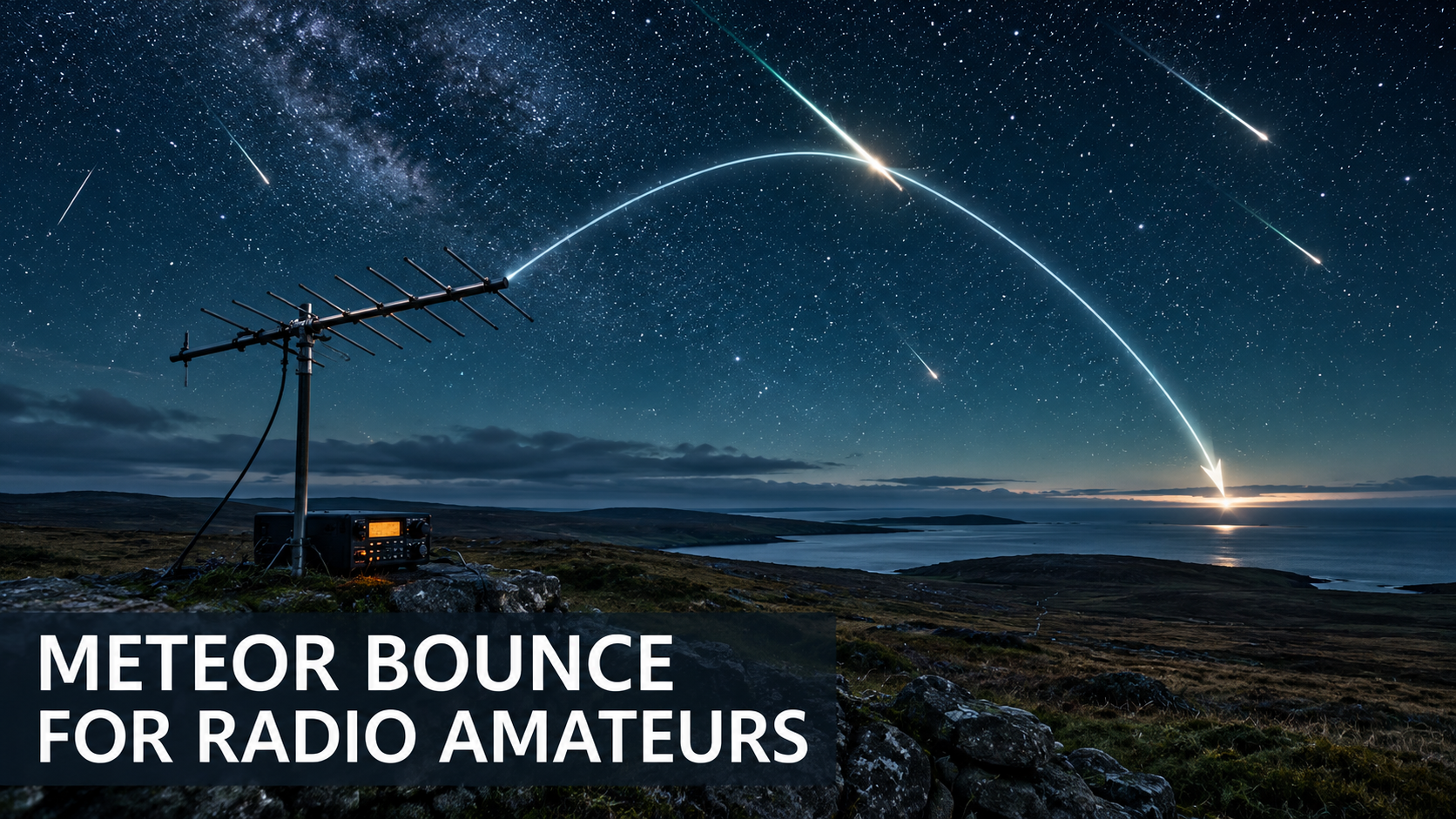
Meteor bounce, usually called meteor scatter or meteor burst communication, is one of the most remarkable propagation modes available to radio amateurs. Instead of relying on the ionosphere, troposphere, or a satellite, a VHF signal is reflected or scattered from the ionised trail left behind as a meteor burns up in the upper atmosphere.
These trails normally last for only a fraction of a second to a few seconds. That makes ordinary voice conversation difficult, but it is ideal for short digital exchanges. With modern software such as WSJT-X and the MSK144 mode, radio amateurs can complete contacts across distances of roughly 400 to 2,000 kilometres, often using modest stations.
Meteor scatter is available every day of the year, although activity becomes much more productive during major meteor showers such as the Perseids in August and the Geminids in December.
How meteor bounce works
As a meteor enters Earth’s atmosphere, typically at an altitude of around 50 to 75 miles (80 to 120 kilometres), friction and compression heat it intensely. The meteor ablates, leaving behind a narrow cylinder of ionised gas. That ionised trail can act as a fleeting reflective and scattering medium for radio signals.
A transmitting station sends a signal towards the region of sky where a meteor trail may appear. If a suitable trail forms in the right place, part of the signal is scattered forward towards another station well beyond normal line-of-sight range. The receiving station may hear only a brief “ping” lasting milliseconds, or occasionally a longer reflection lasting several seconds.
The key challenge is that neither operator knows precisely when or where a usable trail will appear. Meteor scatter therefore uses repeated, precisely timed transmissions and receptions, allowing two stations to exchange small pieces of information over multiple pings until the contact is complete.
Why it works on VHF
Meteor scatter is particularly effective in the VHF range because the ionised trails can reflect or scatter signals at frequencies that would normally travel only limited distances at ground level. Amateur activity is most common on the 6-metre and 2-metre bands, with some operation also taking place on 10 meters and, less commonly, 70 centimetres.
At lower VHF frequencies, such as 50 MHz, a single meteor trail may support communication for tens of seconds or even a few minutes. On 144 MHz, the usable reflection is often much shorter, sometimes lasting only a few seconds or less. This is why digital modes and disciplined operating procedures are so important on 2 meters.
Meteor scatter should not be confused with troposcatter, sporadic-E propagation, or EME (“moonbounce”). Meteor scatter specifically uses the short-lived ionised trail of a meteor as the reflecting medium.
Bands and distances
Meteor-scatter bands
| Band | Typical use | Typical path length | Notes |
|---|---|---|---|
| 10 m – 28 MHz | Meteor scatter and DX | Several hundred to over 2,000 km | Longer reflections are more likely; useful during showers |
| 6 m — 50 MHz | Very popular for MSK144 | About 400 to 2,000 km | A major band for modern meteor-scatter operation |
| 2 m — 144 MHz | Classic meteor-scatter band | Roughly 500 to 2,300 km | Short pings; requires accurate timing and efficient digital modes |
| 70 cm — 432 MHz | Occasional experimental use | Shorter and more demanding | Reflections are weaker and briefer than at 144 MHz |
Meteor-scatter contacts are reported most often between stations roughly 500 and 2,300 km apart, with 6 metres and 2 metres being the principal amateur bands. Ref: ARRL
Digital modes: MSK144
Modern meteor-scatter operation is dominated by MSK144, a digital mode included in WSJT-X. MSK144 was designed specifically for the short, intermittent signals produced by meteor trails.
Instead of trying to transmit a long conversation, stations exchange compact messages in timed cycles. A typical MSK144 sequence uses 15-second transmit and receive periods. Each transmission contains only the essential information needed to progress the contact: call signs, grid squares, signal reports, and confirmation messages.
Because the mode is highly efficient and includes error correction, a contact can be completed even when individual received signals are extremely brief. Operators may need several exchanges before both stations have successfully copied the required information.
Typical MSK144 exchange
A normal MSK144 meteor-scatter contact follows a structured sequence:
1. Station A transmits its call sign and grid square.
2. Station B receives part or all of the message and replies with its own call sign and grid square.
3. Station A sends a signal report, often using the standard report format.
4. Station B acknowledges the report.
5. Station A sends “RRR” to confirm receipt.
6. Station B sends “RR73” or “73” to close the contact.
Because pings are random, either station may miss part of an exchange. The process simply continues until both stations have copied the necessary elements.
Frequencies and operating
On 6 meters, 50.260 MHz is widely used as the primary MSK144 calling and operating frequency. On 2 meters, activity is commonly found around 144.175 to 144.225 MHz, although operators should always check current band plans, local practice, and their license conditions before transmitting.
Meteor scatter can be operated in two main ways:
- Random operation: Stations call CQ and listen for replies from unknown stations.
- Scheduled operation: Two stations agree in advance on a frequency, time, and exchange sequence.
Random operation is excellent for discovering activity, while scheduled operation is useful for completing a difficult path or working a specific grid square.
During major showers, activity can be dense enough that several stations may be operating on the same frequency. Because meteor reflections occur from different parts of the sky, this can still work effectively, but operators should follow established procedures and avoid unnecessary transmissions.
Station setup
A meteor-scatter station does not need to be enormous, but a few elements make a substantial difference:
- A transceiver covering 6 meters and/or 2 meters, preferably with a stable frequency reference.
- A directional antenna, such as a 5- to 7-element Yagi, mounted horizontally and aimed towards the intended propagation area.
- A low-noise pre-amplifier, particularly useful for weak 2-metre signals.
- A computer running WSJT-X.
- An accurate computer clock, synchronised to an internet time source.
- A reliable interface for audio, PTT, and CAT radio control.
- Accurate timing is essential. MSK144 relies on synchronised 15-second cycles, so a computer clock that is even slightly wrong can cause missed transmissions and failed contacts.
Antenna aiming
Unlike a terrestrial point-to-point contact, meteor scatter does not require both antennas to point directly at one another. Instead, each station aims towards a common region of sky where meteors are likely to create useful trails.
For stations in the UK and Europe, a useful starting approach is to beam roughly north or south, depending on the intended contact path and the geometry of the reflection zone. During a major shower, the radiant position of the shower can also help guide antenna direction.
A horizontal Yagi is generally preferred because it spreads energy across a broad area of sky, increasing the chance that a suitable meteor trail will lie within the scattering region.
When to operate
Meteor scatter is possible at any time of year, but success rates rise substantially during meteor showers. Major annual showers include:
- Quadrantids: early January
- Lyrids: April
- Eta Aquariids: early May
- Perseids: August
- Orionids: October
- Leonids: November
- Geminids: December
The early morning hours often provide better results because Earth’s direction of travel sweeps up more meteoroids. However, operators should not ignore other periods: random meteors enter the atmosphere continuously, and MSK144 has made everyday meteor-scatter contacts much more practical than they were in the era of high-speed CW.
Meteor trails form at altitudes around 80 to 120 km, and their brief ionisation is what makes the propagation mode possible.
Active now
Coming up
Practical tips
- Use MSK144 rather than trying to hold an SSB or CW conversation during a brief ping.
- Keep transmissions short and follow the standard exchange sequence.
- Ensure your computer clock is synchronised before every session.
- Use a directional antenna and experiment with its bearing.
- Listen before transmitting; identify activity and avoid transmitting over an exchange in progress.
- Start on 6 meters, where pings tend to last longer and contacts are often easier to complete.
- Be patient: a QSO may take several minutes, particularly on 2 meters.
- Log grid squares, frequency, mode, time, and signal reports for each contact.
- Check that your operating complies with your license conditions and the current band plan for your location.
Why radio amateurs enjoy it
Meteor bounce combines astronomy, propagation, timing, and radio operating into one fascinating activity. A contact may depend on a piece of space debris entering the atmosphere at exactly the right moment, in exactly the right part of the sky, and being intercepted by two stations that have positioned themselves to make use of it.
For many VHF operators, that unpredictability is part of the appeal. A meteor-scatter contact is not merely a long-distance QSO; it is evidence that a tiny particle entering the upper atmosphere briefly created a radio mirror between two stations hundreds or thousands of kilometers apart.



Leave a Reply
You must be logged in to post a comment.