
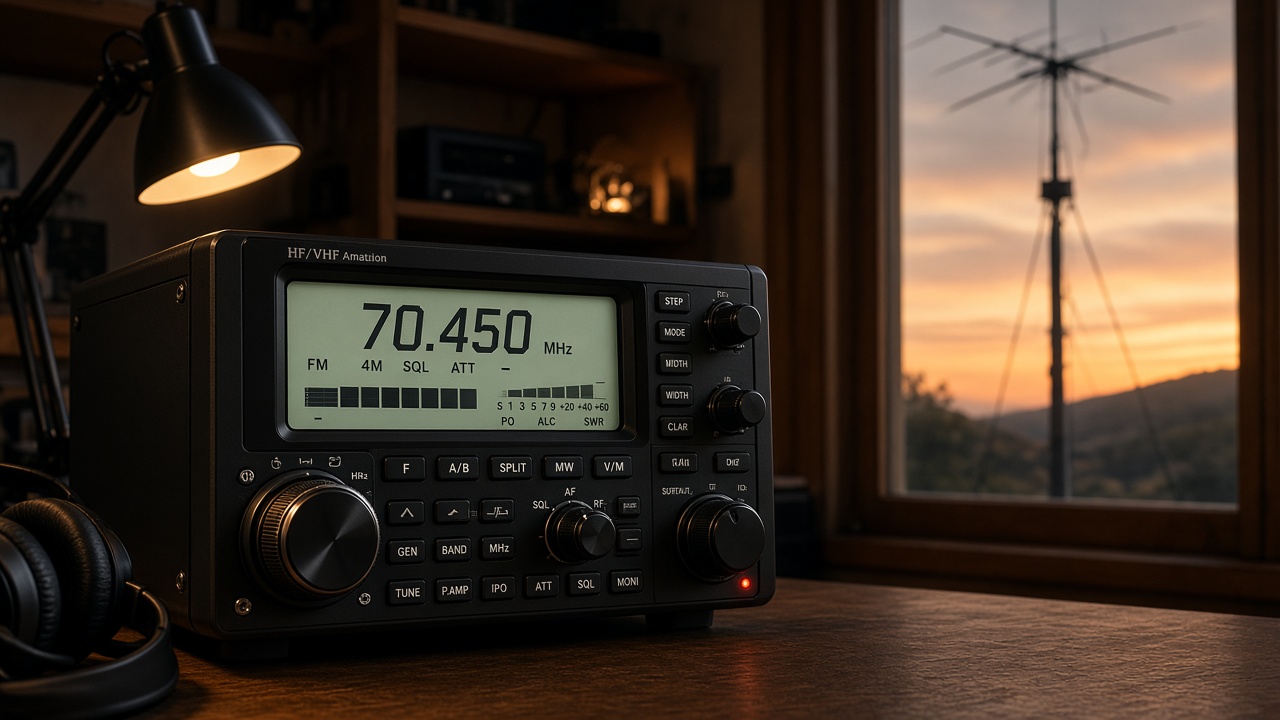
The 4-metre band (70.0–70.5 MHz) is one of the quieter VHF allocations in the UK. It sits between 6 metres and 2 metres and has a character of its own: less crowded than 2 m, capable of solid local and regional contacts, and open to useful Sporadic-E in the summer. It is much more of an ‘Experimenters band’ than any of the other VHF bands.
A short history
The old 5-metre band (58.5–60 MHz) was closed to amateurs in 1949 so that Band I television could expand. In 1956 the RSGB successfully argued for a new VHF allocation, and on 9 November 1956 the 4-metre band was opened to UK amateurs as a temporary 200 kHz segment: 70.2–70.4 MHz.
It was later extended. By the late 1960s the limits were roughly 70.025–70.7 MHz; in 1982 they were trimmed to 70.025–70.5 MHz, and in 1987 the present allocation of 70.0–70.5 MHz was formalised. Class B (no-Morse) licensees gained access the same year. The band remains secondary, with a full-licence power limit of 160 W (22 dBW).
For decades it was almost unique to the UK, Ireland, Gibraltar and a few other places. That scarcity of allocations, combined with the near-absence of ready-made equipment, shaped its culture.
Why it is called the Gentleman’s Band
The nickname comes from the operators themselves. For a long time almost everyone on 4 m either built their own gear or modified ex-commercial low-band PMR sets. The community was small, people knew one another by first name, and contacts tended to be longer and more technical than the rapid-fire exchanges common on 2 m. The band acquired a reputation for courtesy and unhurried conversation — hence “the Gentleman’s Band.”
Even today it retains some of that character. Occupancy is still modest, nets are friendly, and many operators still enjoy the experimental side of the band.
Why it is a good band
- Local and regional range. Propagation is generally better than 2 m for the same power and antenna height. A modest vertical or halo will often give reliable contacts further than expected.
- Less congestion. Far fewer stations are active than on 2 m, so there is more room for nets, ragchews, and experimental work.
- Sporadic-E. In the summer months 4 m produces more frequent and often stronger Es openings than 2 m. The first clue is usually distorted Eastern European FM broadcast stations appearing at the bottom of the band.
- Other modes. Aurora, meteor scatter, and tropospheric enhancement all work well. There is also a long history of useful AM activity.
- Practical antennas. A simple vertical or a small Yagi is effective. Many operators reuse or adapt low-band PMR antennas.
Calling frequencies (UK band plan):
- 70.200 MHz — CW/SSB
- 70.260 MHz — AM/FM
- 70.450 MHz — FM
Radios that currently work on 4 m
Dedicated Japanese multi-band sets that include 70 MHz as standard (or easily enabled for the UK/Europe):
- Icom IC-7300 (and the newer IC-7300MK2) — HF/50/70 MHz, 100 W on HF/6 m, 50 W on 4 m. One of the most popular ways onto the band.
- Icom IC-7100 — HF/50/70/144/430 MHz, includes 4 m and D-STAR.
- Yaesu FT-710 — HF/50 MHz as standard; 70 MHz TX can be enabled by a region change (no hardware modification).
- Yaesu FTDX10 — UK/European versions include 70 MHz.
Dedicated 4 m FM mobiles (simpler and cheaper for local FM work):
- Anytone AT-588 (66–88 MHz version) — widely available, up to about 45 W, CTCSS/DCS, easy to program. A practical choice if you mainly want FM.
Other options that still appear:
- Converted low-band PMR sets (Motorola GM350 and similar) remain popular and inexpensive.
- Transverters (e.g. from 10 m or 2 m) for operators who already have an HF or VHF radio and want SSB/CW.
- Specialist UK-made kits and sets for home-brew or small-run equipment.
Getting started
A vertical or halo antenna and a radio that covers 70 MHz is enough for local FM. For SSB/CW, the IC-7300 or FT-710 (once enabled) gives full access with modern features. Listen around 70.450 MHz for FM activity and 70.200 MHz for SSB, especially in the evenings and during summer Es season.
The band is secondary, so keep power and antenna gain within the licence limits and be prepared to stop if interference is reported. Beyond that, it remains one of the more pleasant and under-used VHF bands available to UK amateurs — and still carries a little of the old Gentleman’s Band reputation.
Sources: RSGB 70 MHz band plan and licence notes; Ofcom amateur licence conditions; contemporary accounts of the band’s culture (including the “Gentleman’s Band” nickname); manufacturer specifications for IC-7300, IC-7100, FT-710, FTDX10, and Anytone AT-588.


Leave a Reply
You must be logged in to post a comment.