
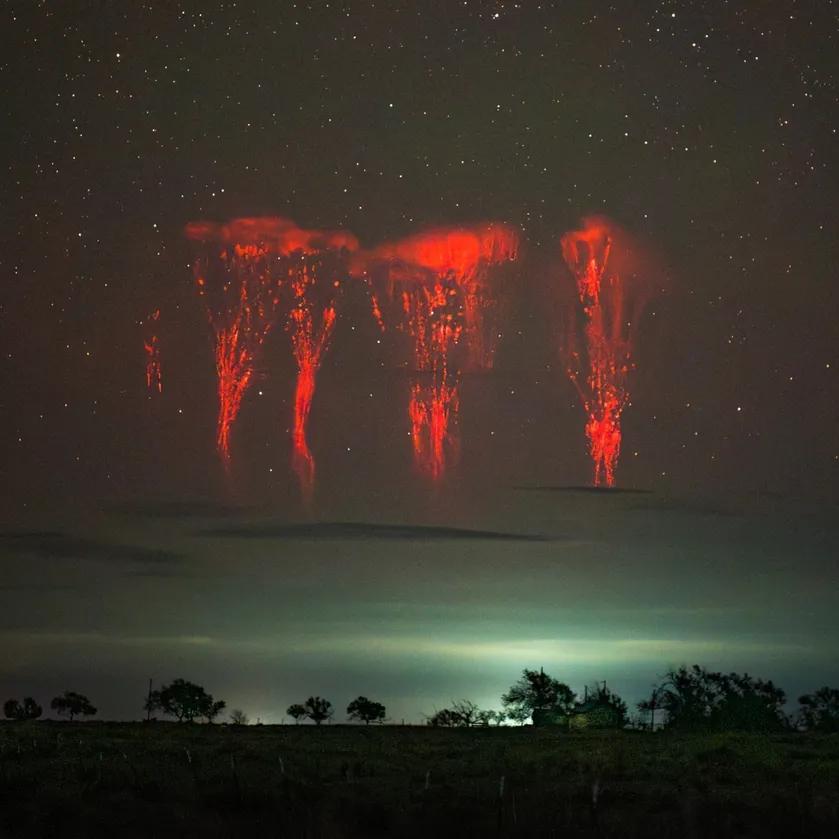
red sprites, blue jets, gigantic jets, ELVES and more.
Lightning is one of the most familiar and dramatic displays of nature. During thunderstorms, enormous electrical discharges illuminate the sky, travelling between clouds, within clouds, and sometimes between clouds and the ground. However, what many people do not realise is that lightning does not always travel downwards towards the Earth.
Far above ordinary thunderstorms, spectacular electrical events take place in the upper atmosphere, producing flashes of red, blue and purple light that can extend for tens of kilometres. These phenomena are collectively known as Transient Luminous Events (TLEs). They include red sprites, blue jets, gigantic jets, ELVES and several less familiar forms of upper-atmospheric electrical activity.
For many years, these unusual flashes were largely unknown to science. Some were reported by pilots, but their brief duration and enormous altitude made them difficult to observe. Today, advances in photography, high-speed cameras and satellite observations have allowed scientists to study these extraordinary events and better understand the complex electrical relationship between thunderstorms and the atmosphere above them. Red sprites are perhaps the most recognisable of these phenomena, resembling enormous, branching red tendrils suspended above storm clouds. Yet they are only one part of a much larger and more fascinating electrical system.
What are Red Sprites?
Red sprites are large-scale electrical discharges that occur high above powerful thunderstorms, typically in the mesosphere, at altitudes of approximately 50–90 kilometres above the Earth’s surface. Unlike conventional lightning, which usually travels within clouds or between clouds and the ground, sprites develop above the thunderstorm, sometimes appearing to descend from the lower edge of the ionosphere towards the tops of storm clouds. They are usually reddish-orange in colour, although their lower tendrils can appear blue or violet. Their appearance is often compared to jellyfish, carrots, columns or branching trees. Some sprites consist of a single luminous structure, while others appear as multiple flashes spread across the sky.
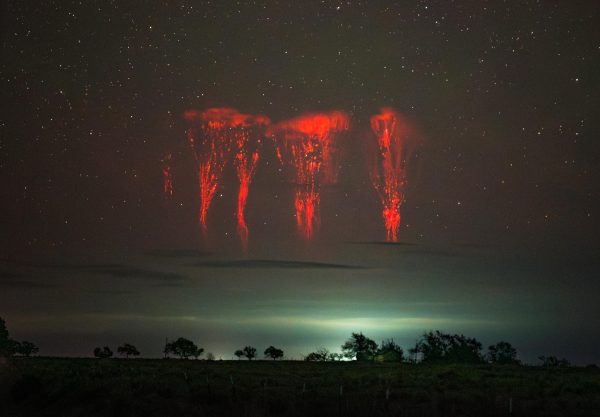
Despite their enormous physical dimensions, sprites are remarkably short-lived. Individual events generally last only a few milliseconds, making them extremely difficult to observe with the naked eye. High-speed cameras are particularly useful because they can capture the intricate structures and rapid development of these discharges.
How do Red Sprites form?
Sprites are closely associated with powerful cloud-to-ground lightning strikes, particularly positive cloud-to-ground discharges. During a thunderstorm, electrical charges become separated within the cloud. Typically, positive charge accumulates towards the upper regions and negative charge towards the lower regions, although real thunderstorm charge structures can be considerably more complicated. When a powerful lightning discharge transfers a substantial amount of electrical charge between the cloud and the ground, it produces a sudden change in the electric field above the storm. This change can create an electric field in the mesosphere strong enough to accelerate free electrons.
These energetic electrons collide with nitrogen molecules in the thin upper atmosphere, exciting them and producing light as they return to lower energy states. The reddish colour is primarily associated with emissions from excited molecular nitrogen. The resulting electrical breakdown develops into narrow, rapidly expanding filaments known as streamers. These streamers produce the branching, tendril-like appearance that makes sprites so distinctive. An important point is that sprites are not simply ordinary lightning bolts travelling upwards. They are a different type of electrical discharge occurring in atmospheric conditions where the air is considerably thinner.
When were red sprites discovered?
Although there are historical accounts of unusual flashes above thunderstorms, sprites were not scientifically confirmed until 1989. Researchers at the University of Minnesota were testing a low-light television camera in preparation for a rocket experiment when they accidentally recorded two luminous flashes above a distant thunderstorm. This discovery opened up an entirely new area of atmospheric research. Further observations, including the 1994 Sprites94 aircraft campaign, helped scientists establish their altitude, physical dimensions and relationship with conventional lightning. The name sprite was chosen because of their elusive and fleeting appearance, rather than because of any particular physical property. NASA has since supported research into these events, including citizen-science initiatives that encourage photographers to capture and report upper-atmospheric electrical activity.
Reference: NASA, Spritacular: NASA’s New Citizen Science Project to Capture Elusive Upper Atmospheric Electrical Phenomena on Camera (2022). Read the NASA article.
2. Blue jets – electrical discharges reaching towards space
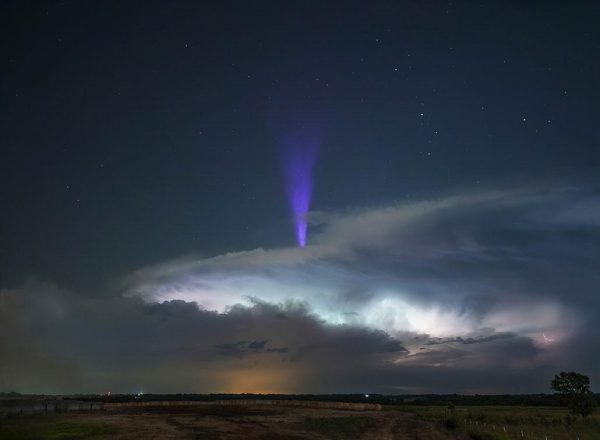
While red sprites develop high above thunderstorms, blue jets originate much lower in the atmosphere and travel upwards from the tops of thunderclouds. They are generally observed emerging from the upper regions of cumulonimbus clouds, travelling into the stratosphere and sometimes reaching altitudes of approximately 40–50 kilometres. Some observations and classifications place their upper extent closer to 60 kilometres. Unlike sprites, which are generally triggered by the electric-field changes associated with powerful lightning strikes, blue jets are thought to develop through electrical breakdown processes within the thundercloud itself.
Their appearance is quite different from red sprites. Blue jets typically resemble narrow, cone-shaped or fountain-like discharges, expanding as they travel upwards. They are predominantly blue because of light emissions associated with excited molecular nitrogen. Blue jets can travel at speeds of tens to around 100 kilometres per second, making them extremely fast atmospheric phenomena.
Their visible development can last hundreds of milliseconds, although the exact duration varies. One particularly interesting aspect of blue jets is that they demonstrate how electrical activity within thunderstorms can extend far beyond the visible cloud structure. They also provide scientists with valuable information about the electrical properties of the stratosphere, a region that is normally difficult to investigate using conventional lightning observations.
3. Gigantic jets – when thunderstorms connect with the ionosphere
Gigantic jets are among the most impressive electrical phenomena associated with thunderstorms. As their name suggests, they are considerably larger than ordinary blue jets.
Rather than stopping within the stratosphere, gigantic jets can extend from the top of a thunderstorm through the stratosphere and mesosphere, sometimes reaching altitudes of approximately 70–90 kilometres. At these heights, they can approach or interact with the lower ionosphere. The ionosphere is a region of the upper atmosphere containing electrically charged particles, produced largely through interactions between atmospheric gases and solar radiation.
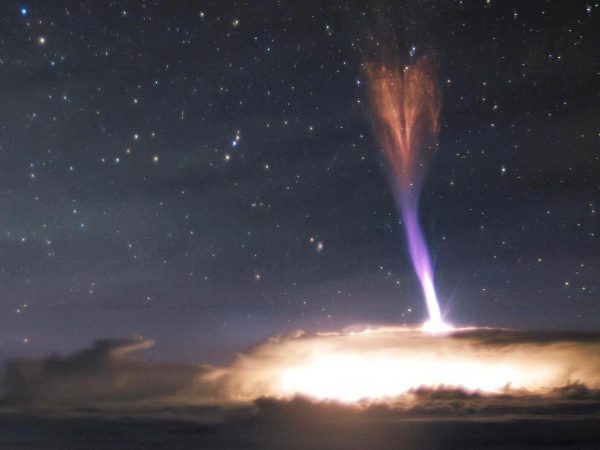
Gigantic jets are particularly interesting because they can create a direct electrical connection between a thunderstorm and the lower ionosphere. This makes them important to our understanding of how energy and electrical charge are transferred between different atmospheric layers. Their structure often resembles a huge blue tree or branching fountain, with a bright central channel extending upwards and numerous smaller branches spreading outwards. Gigantic jets are relatively rare compared with ordinary lightning and sprites, and they are not always easy to distinguish from other upward-propagating discharges. Their discovery and subsequent observation have helped demonstrate that thunderstorms are not electrically isolated systems. Instead, they can influence atmospheric regions many tens of kilometres above them.
4. ELVES – enormous expanding rings of light
One of the strangest upper-atmospheric phenomena is known as an ELVE. The name is an acronym for Emission of Light and Very Low Frequency perturbations due to Electromagnetic Pulse Sources. Unlike sprites and jets, ELVES generally appear as enormous, rapidly expanding rings or flattened discs of light near the lower ionosphere, at approximately 85–95 kilometres above the Earth’s surface. They are produced by the electromagnetic pulse generated by an intense lightning discharge. When lightning strikes, it produces a powerful electromagnetic pulse that travels upwards through the atmosphere. When this pulse reaches the lower ionosphere, it can excite atmospheric molecules and produce a brief flash of light. The resulting luminous region expands horizontally at an enormous speed, sometimes reaching several hundred kilometres in diameter.
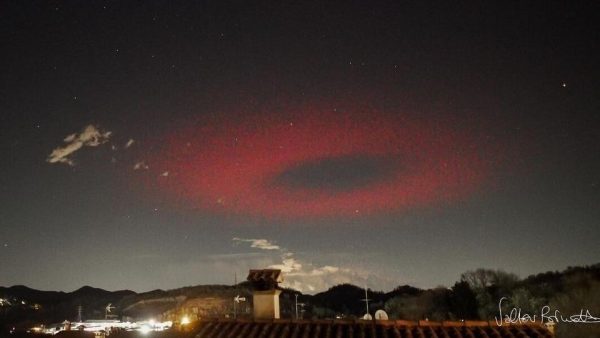
ELVES are exceptionally short-lived. Their visible emission can last less than one millisecond, making them among the most difficult transient luminous events to capture. Their colour is generally reddish, resulting largely from emissions associated with atmospheric nitrogen. What makes ELVES especially interesting is their immense horizontal size. Whilst sprites can extend across tens of kilometres, ELVES can spread across hundreds of kilometres almost instantaneously. They are therefore an excellent example of how an electrical event occurring within a thunderstorm can produce effects across a vast region of the upper atmosphere.
5. Sprite halos – the glowing regions surrounding sprites
Sprite halos are another form of transient luminous event, often occurring in association with the same powerful lightning discharges responsible for sprites. They generally appear at altitudes of approximately 70–85 kilometres and take the form of a broad, diffuse, flattened glow. Unlike the highly structured tendrils of a sprite, a halo is usually much smoother in appearance, resembling a faint luminous disc or flattened sphere above the thunderstorm.
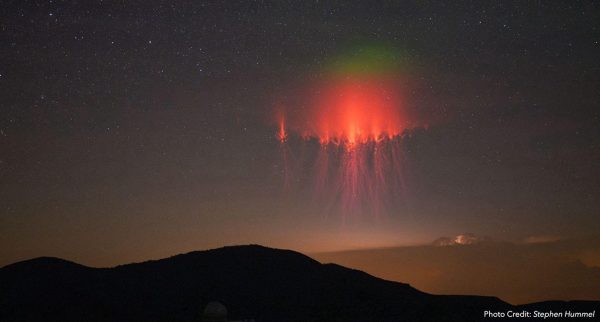
Halos are produced by the electric field associated with a powerful lightning discharge. This field accelerates electrons, which collide with atmospheric molecules and produce light. They are often considered closely related to sprite formation and can sometimes precede a more developed sprite. However, not every halo develops into a sprite, and the two phenomena can occur independently. Because halos are generally very brief and relatively diffuse, they can be difficult to identify without sensitive cameras and carefully timed observations.
6. Other unusual upper-atmospheric electrical phenomena
Blue Starters
Blue starters are upward electrical discharges that resemble blue jets but do not extend as high into the atmosphere. They generally reach approximately 20–25 kilometres, remaining within the lower stratosphere. They are thought to represent a less developed form of upward electrical discharge.
TROLLs
TROLLs, short for Transient Red Optical Luminous Lines, are unusual red optical features associated with the aftermath of sprites. They are generally faint and can appear as short-lived horizontal or downward-extending luminous structures.
Gnomes and pixies
These are informal names given to small-scale luminous features observed near thunderstorm tops and in association with other transient luminous events. They are much less extensively documented than sprites, jets and ELVES.
7. How do these phenomena differ?
Although all these events are associated with thunderstorms, they differ significantly in their altitude, appearance, formation mechanisms and duration. The following table provides a simplified comparison of the main types.
| Phenomenon | Approximate altitude | Typical appearance |
|---|---|---|
| Red sprites | 50–90 km | Red branching tendrils |
| Blue jets | 15–50 km | Blue upward cones |
| Gigantic jets | 15–90 km | Huge branching blue discharges |
| ELVES | 85–95 km | Expanding circular flashes |
| Sprite halos | 70–85 km | Diffuse luminous discs |
| Blue starters | Up to 20–25 km | Short upward blue discharges |
Altitudes are approximate observational ranges. Individual events can fall outside these ranges, and published classifications sometimes differ.
One of the most important distinctions is that not all TLEs are actually lightning bolts in the conventional sense. Some, such as sprites and jets, involve electrical breakdown and streamer development, whereas ELVES are primarily produced by the electromagnetic pulse from a lightning discharge.
8. Why are these phenomena different colours?
One of the most visually striking characteristics of high-altitude lightning is its range of colours.
Ordinary lightning appears predominantly white or bluish-white, whereas upper-atmospheric electrical phenomena can appear red, orange, violet and blue.
This difference is largely explained by the atmospheric gases involved and the way they respond to electrical energy.
The Earth’s atmosphere is composed primarily of nitrogen and oxygen. When energetic electrons collide with these molecules, they can transfer energy to them, leaving them in excited electronic or vibrational states.
As these molecules return to lower energy states, they release energy in the form of electromagnetic radiation, including visible light. Different molecular transitions produce different wavelengths and therefore different colours.
Red and orange: These colours are strongly associated with emissions from excited molecular nitrogen, particularly in the upper atmosphere.
Blue and violet: These are associated with different nitrogen emission bands and, in some circumstances, molecular nitrogen ions.
Purple: This can result from overlapping blue and red emissions, particularly in complex sprite structures.
Altitude also plays an important role. Atmospheric density decreases with height, changing how energetic particles collide with molecules and how the resulting light is emitted.
This is one reason sprites can have bright reddish upper regions and blue or violet tendrils lower down.
9. The relationship between thunderstorms and space
Perhaps the most important scientific implication of transient luminous events is that they demonstrate how closely connected the Earth’s atmosphere and near-space environment really are.
Traditionally, thunderstorms were considered primarily tropospheric weather systems, with their electrical activity largely confined to clouds and the surrounding atmosphere.
However, the discovery of sprites, jets and ELVES has revealed that thunderstorms can influence atmospheric regions extending well into the mesosphere and lower ionosphere.
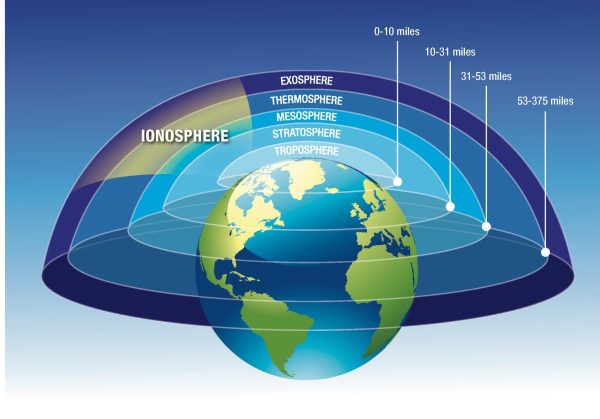
The atmosphere is divided into several layers:
Troposphere: Extends from the surface to approximately 8–18 kilometres, depending on latitude and weather conditions. Most thunderstorms develop here.
Stratosphere: Extends to approximately 50 kilometres. Blue jets can propagate into this region.
Mesosphere: Extends from approximately 50 to 85 kilometres. This is where much of the visible activity associated with sprites occurs.
Thermosphere: Begins around 85 kilometres and extends hundreds of kilometres upwards. The lower ionosphere overlaps with these upper atmospheric regions.
The boundaries between these layers are not perfectly sharp, and the ionosphere is not a separate atmospheric layer. It is an electrically active region that overlaps several of the conventional atmospheric layers. Transient luminous events provide scientists with a way to investigate the electrical coupling between these regions. They also raise interesting questions about atmospheric chemistry, energy transfer and the influence of thunderstorms on the near-space environment. Research suggests that some of these electrical discharges can produce chemically active compounds, including nitrogen oxides, although the overall impact on global atmospheric chemistry remains an area of investigation.
10. How are red sprites and other TLEs studied?
Studying these phenomena presents a considerable challenge. Their enormous altitude, short duration and relatively low brightness make them difficult to observe using conventional photography. Scientists use several different techniques to investigate them.
High-speed photography
High-speed cameras are among the most important tools for studying sprites and other TLEs. By recording hundreds or thousands of frames per second, researchers can examine how these discharges develop, spread and disappear.
Low-light cameras
Sensitive cameras allow researchers to capture faint atmospheric emissions that would otherwise be invisible to ordinary photographic equipment.
Satellite observations
Satellites provide a valuable perspective from above thunderstorms, allowing researchers to observe large-scale electrical phenomena that may be difficult to capture from the ground.
The International Space Station has also been used for observations of TLEs.
Radio and electromagnetic measurements
Lightning produces electromagnetic signals that can travel through the atmosphere and into the near-Earth space environment. By studying these signals, researchers can investigate the relationship between ordinary lightning and the luminous events above it.
Ground-based observations
Photographers and research teams often position cameras hundreds of kilometres away from active thunderstorms. Looking towards the storm from a dark location can provide an excellent opportunity to capture sprites and other upper-atmospheric phenomena.
NASA’s Spritacular project is an interesting example of how citizen scientists can contribute to this research by submitting photographs and observations.
11. What remains unknown?
Despite considerable progress over the last few decades, there is still much to learn about transient luminous events.
Scientists continue to investigate why some thunderstorms produce sprites while others do not, even when they appear to have similar lightning activity.
The precise electrical conditions required for different types of TLEs are also an important subject of research. Other unanswered questions include:
How frequently do different types of TLEs occur around the world?
How do atmospheric temperature, pressure and composition influence their formation?
What is the full chemical impact of these electrical discharges?
How frequently do gigantic jets establish electrical connections with the ionosphere?
What determines the complex branching structures found in sprites?
How do these events influence the wider electrical environment surrounding Earth?
Improved satellite instruments, high-speed imaging systems and electromagnetic sensors are helping to answer these questions.
As technology advances, scientists are discovering that the atmosphere is electrically much more active than previously understood.
Conclusion
Red sprites and other high-altitude lightning phenomena provide a fascinating reminder that thunderstorms are capable of influencing far more than the weather immediately around them.
From the branching red tendrils of sprites to the enormous blue columns of gigantic jets and the rapidly expanding rings of ELVES, these events reveal a hidden world of electrical activity occurring tens of kilometres above the Earth’s surface.
Although they are brief and often difficult to observe, their scientific importance is considerable. They help researchers understand atmospheric electricity, the behaviour of charged particles, the interaction between different atmospheric layers and the complex relationship between thunderstorms and the ionosphere.
Perhaps the most remarkable aspect of these phenomena is that they were occurring above us long before we had the technology to properly observe them.
For decades, unusual flashes above thunderstorms were dismissed as unreliable sightings or optical illusions. Today, thanks to modern imaging technology and dedicated scientific research, they are recognised as an important part of Earth’s atmospheric electrical system.
The next time a thunderstorm illuminates the horizon, it is worth remembering that the electrical spectacle may not end at the top of the clouds. High above the storm, an entirely different display of light and electricity may be taking place, largely invisible to anyone looking up from the ground.


Leave a Reply
You must be logged in to post a comment.