
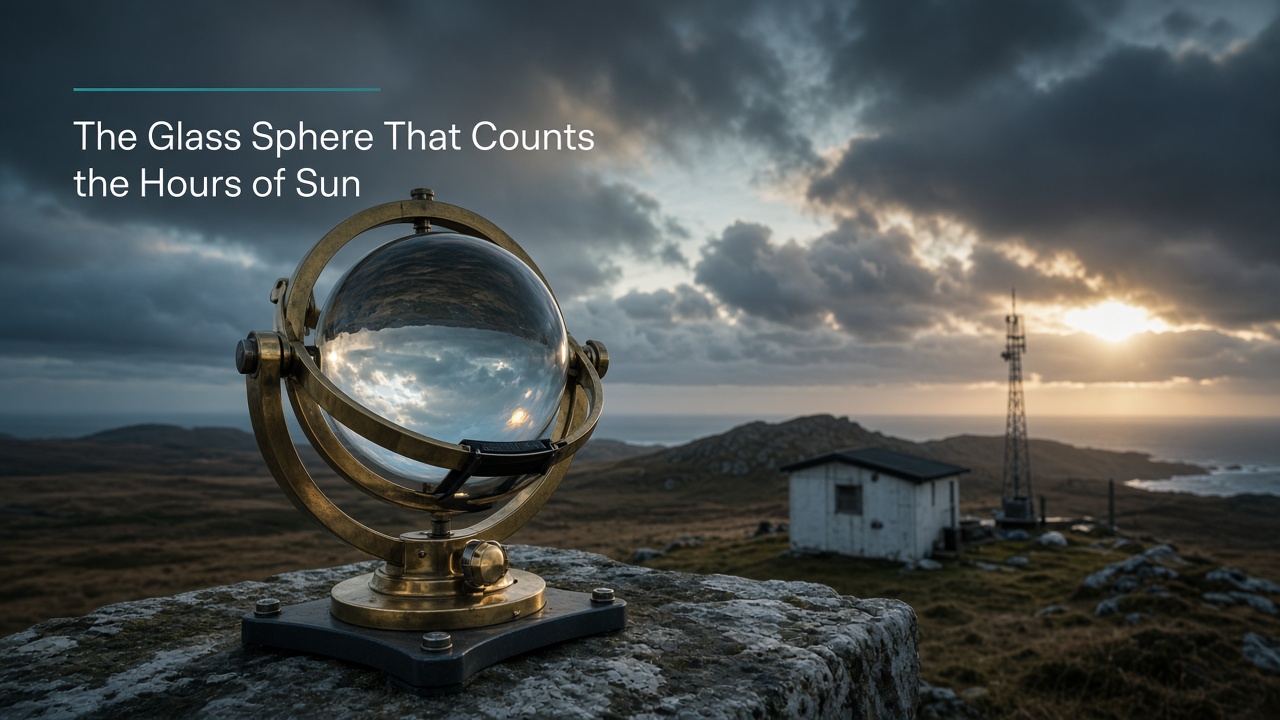
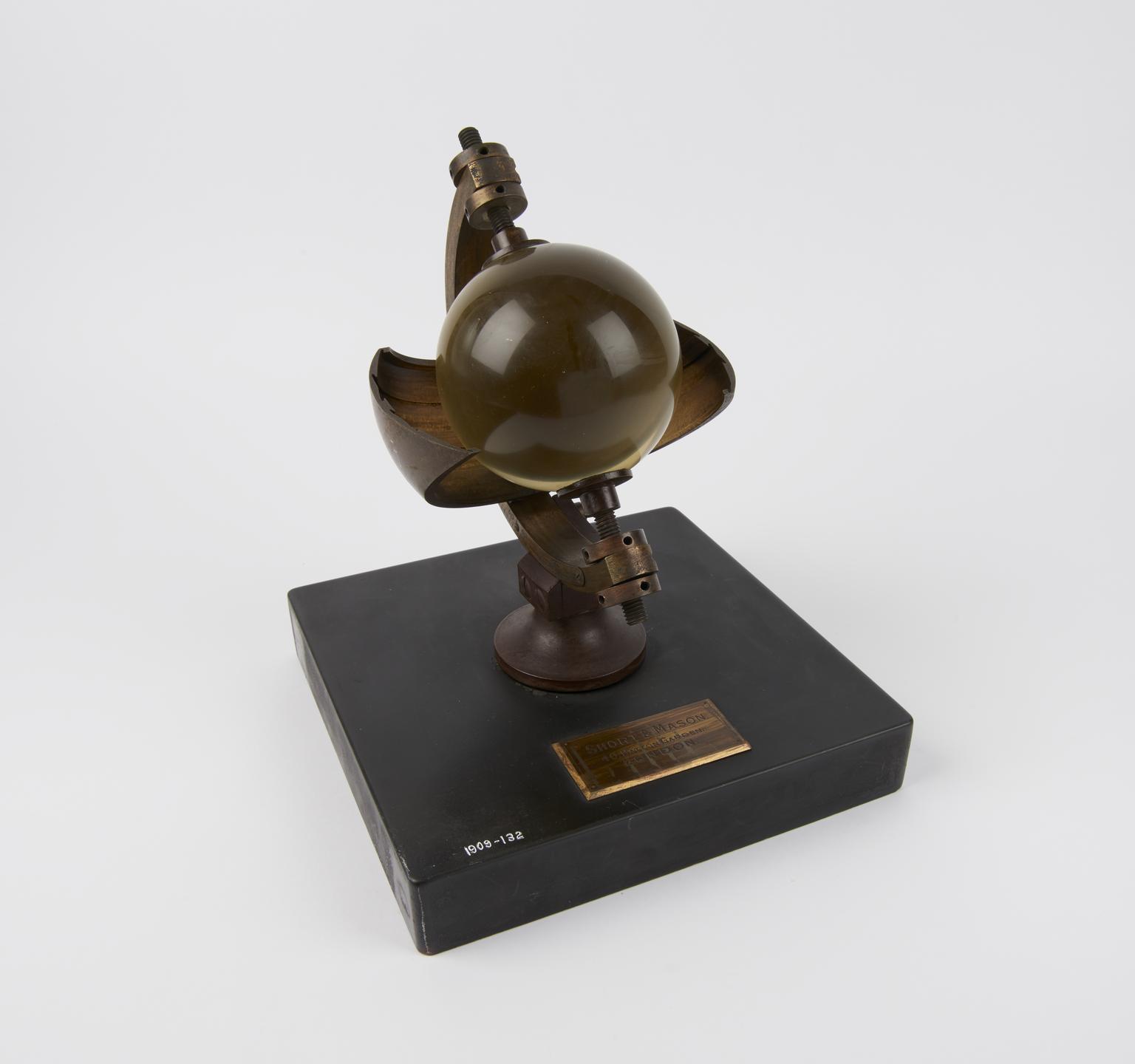
A solid glass ball, about 10 cm across, sits in a curved metal bowl. Behind it, a specially treated card waits. When the sun is strong enough, the sphere focuses its rays to a bright point and scorches a line into the card. At the end of the day you take the card out and measure the length of the burn. That length is the number of hours of bright sunshine.
The instrument is the Campbell–Stokes sunshine recorder. It was invented in 1853 by John Francis Campbell of Islay and refined in 1879 by the Cambridge physicist Sir George Gabriel Stokes. More than 170 years later it is still used at many stations around the world.
How it works
The glass sphere acts as a lens with no preferred direction. Wherever the sun is in the sky, the sphere brings its rays to a focus on the card held in the bowl behind it. The card is marked with hour lines (local solar time) and is designed to char rather than catch fire.
Clouds interrupt the beam, so the burn appears as a broken line. Gaps in the track show when the sun was obscured. Different cards are used through the year because the sun’s altitude changes:
- Winter cards (15 October – 29 February)
- Equinox cards (1 March – 11 April and 3 September – 14 October)
- Summer cards (12 April – 2 September)
The instrument is aligned on a north–south line and set for the station’s latitude. Once that is done, it needs no electricity and almost no maintenance beyond changing the card each day.
The World Meteorological Organization adopted a threshold of roughly 120 W/m² of direct solar radiation as the definition of “bright sunshine.” That figure was chosen in part because it matches the intensity at which a Campbell–Stokes card begins to scorch.
A Scottish invention
John Francis Campbell (1821–1885) was a scholar, folklorist and collector of Highland traditions who lived on the island of Islay. His original 1853 design used a glass ball (initially water-filled, later solid) set into a wooden bowl. The sun burned an arc into the wood itself. A single bowl could be used for months because the sun’s path shifted slightly each day.
Stokes improved the design by replacing the wooden bowl with a metal housing and introducing replaceable cards held in grooves. The combination of Campbell’s idea and Stokes’s practical refinements produced an instrument accurate enough for climatological records. It quickly became the standard sunshine recorder outside the United States.
Why it still matters
The Campbell–Stokes recorder has limitations. It can overestimate sunshine in hazy conditions, it records only duration (not intensity), and it requires a human to change and read the card. Electronic sensors have largely replaced it at major observatories.
Yet it remains in use for two reasons. First, its long historical record is invaluable; many stations have continuous sunshine data stretching back more than a century. Second, it needs no power. In remote or high-latitude locations it is still a reliable way to measure bright sunshine.
On the Isle of Lewis the number of sunshine hours is a practical piece of information, for gardening, for energy, and simply for knowing how the day has gone. The principle behind the glass sphere on a metal stand is the same one Campbell worked out on Islay in the middle of the nineteenth century.
See also: sunshine in the weather glossary, and the live conditions on the Stornoway weather dashboard.
Sources: Curtis (1898); Sanchez-Lorenzo et al. (2013); World Meteorological Organization guidance on sunshine duration.

Leave a Reply
You must be logged in to post a comment.